

When Should You Sell Your Cryptocurrency?

Updated on Sep 18, 2024
Billions of US dollars’ worth of cryptocurrencies are traded daily and that doesn’t even take into account the long-haul HODLers. This niche asset class has become an integral part of a well-diversified portfolio as it is seen as a hedge against movements in traditional assets, especially Forex and commodities, as well as a potential source of outsized returns. However, effective financial management requires selling assets that do not serve you anymore, whether at a profit or at a loss. This article covers why and when is the best time to sell cryptocurrency.

What is the Best Time to Sell Your Crypto?
Cryptocurrencies are a nascent class of assets. Their volatility and capacity to offer returns are much higher than any of the traditional assets. So, the factors to consider while holding or selling a cryptocurrency are quite different. Here is a look at some of them.
The Value has Increased Since You Bought It
Many cryptocurrencies have the potential to generate huge returns. Their high volatility causes profits to snowball in a short span of time. If your cryptocurrency investment has reached the investment target you had set when you bought it, it may be a good time to consider selling your crypto holdings. This is because crypto markets can swing in either direction very quickly and you wouldn’t want to be whiplashed by a sudden downturn. After all, selling higher than you bought is the essence of investing right?
You Have Better Investment Opportunities
The crypto space is evolving rapidly. New and interesting cryptocurrencies, blockchain projects, and decentralized applications are launched every few months. If you have come across an opportunity that is more promising than your current crypto holding, perhaps it’s time to shake your portfolio up.
You No Longer Believe in Its Long-Term Success
Compelling fundamentals are key when HODLing. When your assets are losing investor support, and doubts crop up around the project leadership’s capability of delivering, maybe it’s time to sell. Also, if you cannot see significant development in the market for your cryptocurrency and its price is stagnating, this might be the time to get out.
Things to Consider Before Selling Your Crypto
Often, a cryptocurrency may climb a certain amount and stagnate but still have more potential to grow. It can be tricky and risky to sell all your cryptocurrency holdings. Just like strategising your purchase, you must plan the time to sell your cryptos to ensure optimal profits.
How Much of Your Investment Will You Sell?
The portion of your portfolio you would want to sell should depend on your investment plan. Experts believe that cryptos should constitute a maximum of 5% of your portfolio. You can choose to take profit once your target is achieved or rebalance your portfolio if it is becoming too digital asset heavy.
How Will the Sold Crypto be Taxed?
Consider the laws of your country of residence or anywhere else you will be liable to pay tax. Whether your cryptocurrency earnings are taxed, or the profits you can take away are capped, and how you pay the taxes need to be considered when selling a cryptocurrency. Generally, long-term capital gains have lower taxes than short-term gains, so you may decide to hold your assets a little longer. If your profit is below the tax percentage, you can delay selling till you can take away a significant net profit.
Indicators to Identify When to Sell Your Crypto
Technical indicators can offer insight into the future price movements of assets. They are especially important for intra-day traders, swing traders, and scalpers, and provide price points to sell cryptocurrencies. Some of the popular indicators to use are:
Moving Average Convergence Divergence (MACD)
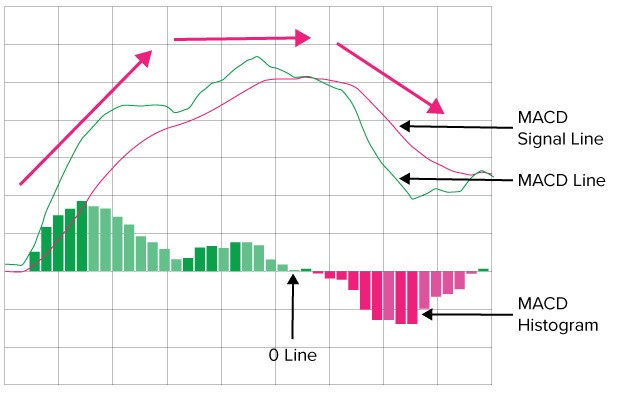
MACD exhibits the relationship between two exponential moving averages (EMAs) of a coin’s price over a certain timeframe. A 9-period EMA works as a signal line and the difference between the 26-period and 12-period EMAs is the MACD line. When the MACD falls below the signal line, it is a signal to sell.
Relative Strength Index (RSI)
RSI indicates the strength of bullish and bearish forces in the market. It’s an oscillator that lies between 0 and 100. A value of 70 or above might indicate that the cryptocurrency is overbought, and a correction will soon exert downward pressure on the price, which makes it a potential signal to sell.
Bollinger Bands
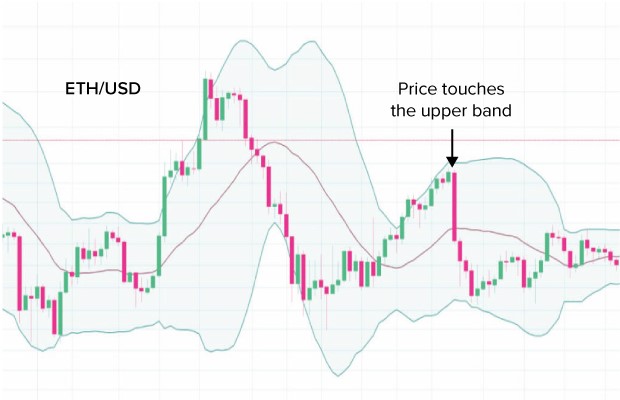
Bollinger Bands form a channel on the price movement chart with a simple or exponential average curve in the middle and two standard deviations on each side of the middle line. Bollinger Banks can be used to identify reversals and sell during an uptrend, when the price touches the upper band and retreats to the middle.
Crypto Selling Strategies:
You can use any of the below strategies to sell your crypto:
– Selling All at Once
Even if you still believe in the crypto you own, you may consider selling all your digital holdings that have gone above the 5% rule. Also, if you wish to take out some capital for investment elsewhere, you can sell a larger portion at once.
– Selling Gradually
If you intend to optimise your gains, selling gradually may be a better idea. You can plan to sell 5-10% of your holdings every week. Do this till your portfolio is rebalanced. Remember that this strategy will yield good profits when the coin has grown significantly since you bought it.
Another technique is to pyramid out your holdings. You start by selling a small portion and gradually increase the percentage you sell, taking away incremental profits. This technique is often favoured during a price rally.
– Short Selling
If you do not own a sizeable amount of cryptocurrencies, you may use futures or CFDs to take advantage of selling opportunities during bear runs. If you expect a downward trend, you may open short positions using leverage and short sell the cryptocurrency. However, make sure to set risk control limits, as leverage amplifies your risk as well as increasing the profit potential.
When Should You Not Sell Your Crypto?
Here at Coin Hint, we wish to remind our readers that cryptocurrencies are highly volatile assets. Selling them partially or clearing out your digital currency holdings is a decision not to be made lightly. Here are some conditions under which you might consider not selling you crypto:
- You have a well-balanced portfolio and your crypto is growing.
- You heard a piece of negative news about another digital asset and are influenced by market panic against your better judgment.
- When you believe that cryptocurrency has unexploited potential to deliver sizeable returns.
- Falling prey to FOMO and exchanging your crypto that has good potential for the new crypto on the block that everyone is talking about but doesn’t really stand up to your analysis.
Conclusion
The digital currency market is still evolving and is not set in its ways. So, the decision of selling cryptocurrencies should be informed and based on hard analysis, not emotion. If you plan on selling, make sure you consider your portfolio diversity and financial targets.
FAQ
-
Should I sell my crypto when it is high?
You could sell your crypto high if you bought low and it has risen significantly or met your profit target.
-
Is it good to buy crypto low and sell it high?
That is a great way. However, cryptos often register longer uptrends. Buying high and then selling even higher during a bull run also works.
-
Does selling crypto increase its price?
Selling does not inherently increase the price of a cryptocurrency. However, markets tend to rise in the long run. So, you may find that the crypto you sold a few months ago has risen considerably after that.
-
Can I sell my cryptocurrency on the same day that I purchased it?
Yes, you can sell your cryptocurrency any time you want. If your profit target has been achieved, you could sell it in even a matter of hours.
-
 What is Yield Farming in Crypto, and Does it Work?Cryptocurrency yield farming emerged in 2020 and quickly grew in popularity. Although the total value of crypto locked up in decentralized finance (DeFi) projects has fallen back somewhat from its initial high, yield farming consistently remains an attractive sector for crypto investors.
 -
 4 Proven Swing Trading Strategies for Cryptocurrency TradersCryptocurrency traders can leverage any number of crypto trading strategies for success. Swing trading is one such strategy, and it offers traders a slower pace than day trading strategies.
 -
 How is a Cryptocurrency Exchange Differ from a Crypto Wallet?The two most common mediums for accessing cryptocurrencies are exchanges and wallets, but their purpose and functionality differ substantially. At the simplest level, exchanges allow users to buy, sell, or trade cryptocurrencies, whereas wallets hold crypto balances and facilitate crypto transfers, but there’s far more to these two crypto tools.
 -
 Exploring Bitcoin Exchange-Traded Funds (ETFs): Benefits and Investment OpportunitiesThe cryptocurrency saw a landmark moment as the US Securities and Exchange Commission approved 11 spot bitcoin exchange-traded funds (ETFs). These ETFs provide mainstream investors regulated access to an asset that tracks the price of Bitcoin without the need to access a cryptocurrency exchange and buy Bitcoin.
 -
 How is a Transaction Verified on a Cryptocurrency Network?In this guide, I will explore how cryptocurrency transactions happen and how blockchain technology secures transactions. Then, I’ll cover the role of nodes and some of the most common consensus mechanisms before touching on some of the issues and concerns and the potential future of transacting with blockchain.
 -
 Learn How to Trade Cryptocurrencies Like a Pro – Step by Step GuideThe following is an overview of how to trade cryptocurrency for beginners. It’s a place to start the in-depth research needed to master cryptocurrency markets and mitigate the risks of beginner cryptocurrency trading strategies.
 -
 Understanding Crypto Arbitrage: Strategies for Low Risk in Crypto TradingOn the financial markets, one of the most potentially profitable, low-risk opportunities for traders is a strategy called arbitrage. Crypto Arbitrage involves capitalizing on asset price discrepancies across different exchanges. Since these discrepancies occur in all financial markets, arbitrage is a well-known practice across all asset classes.